
Basic Page
Basic Page
Published on
2022 Apr 29Marine areas of ecological or biological importance
The identification of marine areas of ecological or biological importance - EBSA in English - is envisaged as an exercise in scientific description carried out under the Convention on Biological Diversity and intended to provide a basis for the identification of areas that may require enhanced protection.
The CBD website dedicated to EBSA is available here.

A process led by experts and generating a wealth of scientific and technical information, the work of EBSA considerably improves the understanding of the oceans. They also provide a solid basis for scientific analysis for Parties and competent authorities to focus their efforts on the conservation and sustainable use of the oceans.
The process also catalyzed partnerships and collaborative initiatives and strengthened the capacity of countries to use EBSAs information in support of planning and management.
The subsequent adoption of conservation and management measures for these areas no longer involves the Secretariat of the Convention on Biological Diversity (CBD) but requires a more complex process, involving States, and even competent intergovernmental organizations and global and regional organizations.

History
In 2002, the World Summit on Sustainable Development adopted the Johannesburg Plan, one of the goals of which was to establish networks of marine protected areas on a global scale by 2012, in accordance with international law, scientific information and discussions about the conservation of biodiversity in areas beyond the high seas.
In 2006, the Conference of the Parties (COP) of the CBD (in its decision VIII/24) recognized that the key role of the Secretariat is to support the work of the United Nations General Assembly with respect to marine protected areas beyond national jurisdiction, with an emphasis on the provision of information and scientific advice concerning biological diversity.
On this basis, the COP convenes an expert workshop to develop a series of streamlined scientific criteria for the identification of marine areas of ecological or biological interest in need of protection in open ocean waters and high seas habitats, based on existing criteria used nationally, regionally or globally.

In 2008, at the Azores workshop, the COP (in its decision IX/20) adopted seven scientific criteria for the identification of EBSA:
1) uniqueness or rarity, 2) particular importance for the stages of the life cycle of species, 3) importance for endangered, or declining species and/or habitats, 4) vulnerability, fragility, sensitivity or slow recovery, 5) biological productivity, 5) biological productivity, 6) biological productivity, 6) biological diversity, 7) natural character.
This decision did not define a specific process for the identification of EBSA, but urged Parties to apply scientific criteria to identify EBSAs that should be protected.
In 2010, the COP (in its decision X/29) requested the Executive Secretary, working as a facilitator, to organize, in cooperation with competent authorities, a series of regional workshops aimed at facilitating the description of EBSAs based on seven adopted criteria and other compatible and complementary scientific criteria agreed at the national and intergovernmental levels. In the same decision, the Secretariat created two mechanisms dedicated to the recognition of descriptions of EBSA, the inventory and the information sharing mechanism, with different modalities.
Since 2011, the CBD Secretariat has convened 15 regional workshops to facilitate the description of areas that meet the criteria for determining EBSAs (North Pacific, Southwest Pacific, Tropical and Eastern Temperate Pacific, Southern Indian Ocean, the Arctic region, the Arctic region, the Mediterranean region, the Mediterranean region, the Mediterranean region, the Mediterranean region, the Mediterranean region, the Mediterranean region, the Mediterranean region, the Mediterranean region, the Mediterranean region, the Mediterranean region, the Mediterranean region, the Mediterranean region, the Mediterranean region, the Mediterranean region, the Mediterranean region, the Mediterranean region, the region, the Mediterranean region, the region, the Mediterranean region, the region, the Mediterranean region, the region, the Mediterranean region, the region, the Mediterranean region To date, 321 areas have been described as meeting the EBSA criteria through these workshops and then reviewed at COP11, COP12, COP13, and COP14. They cover more than 75% of the oceans.
Scope of EBSAs
The results of the regional workshop held in Stockholm in 2019 allowed the Secretariat to recall that the description of areas that meet the EBSA criteria does not imply any position regarding the legal status of a particular country, territory, city or region or region or of its authorities or of its authorities, or of the delineation of its borders. It also has no economic or legal consequences, it is only a scientific or technical exercise.
Description of EBSA at national and regional level
Currently, the only method of identifying an EBSA is the meeting of experts in a regional workshop organized by the CBD Secretariat. However, a state is competent to describe an EBSA through a national process.
In 2017, the total number of EBSAs was 279. Of this total, 169 were located in areas under national jurisdiction, 37 were located in more than one EEZ, 38 were located partially within one or more EEZs and beyond national jurisdiction, and 33 were located exclusively beyond national jurisdiction.
The description of EBSA at the national level:
A state can, through a national process, designate EBSAs within its exclusive economic zone by developing its own guidelines and criteria, which usually correspond to CBD criteria (example of Canadian national criteria: uniqueness, aggregation, impact on physical condition, resilience and naturalness). These descriptions can then be used in decision making for marine conservation planning.
The State may have to choose between the two possible ways to endorse the description of its new EBSA. The national channel allows information to be entered directly into the information exchange mechanism, without intervention by the Secretariat, while the international channel requires the involvement of the SBSTTA and the COP in order for the information to appear in the inventory. The latter requires the State to participate in regional workshops.
The description of EBSA at the regional level:
The Secretariat, in collaboration with Parties, other governments and relevant organizations, organizes regional or subregional workshops at the request of the Parties.
CBD Parties concerned with the area covered by the regional workshop are invited to nominate scientists to attend.
Areas under national jurisdiction are also included in the geographical scope of regional workshops when the countries concerned so wish.
Workshop participants use a model provided by the Secretariat to assess areas against criteria. They rely on scientific data and articles to justify these descriptions. Sub-groups focus on specific geographic areas to facilitate their review.
Competent organizations may choose to use EBSAs information to advance the implementation of ecosystem approaches for the conservation and sustainable use of areas both within and beyond national jurisdiction.
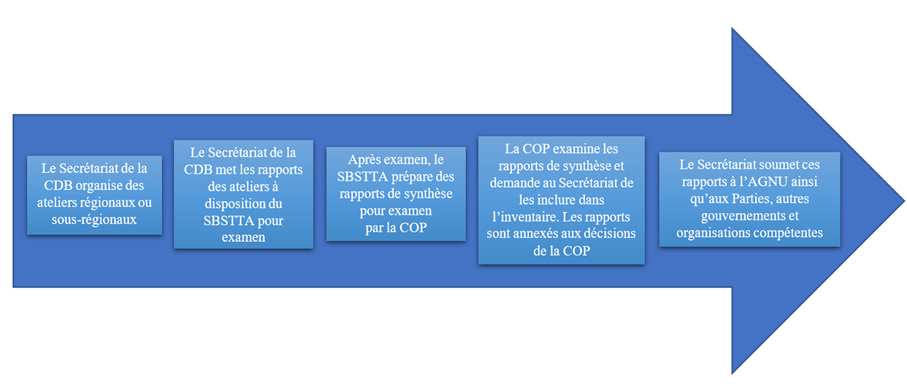
The inventory and the information sharing mechanism
The inventory:
In its decision X/29, the CBD Secretariat, in collaboration with other organizations, established, at the request of Parties, a global inventory of information and scientific and technical experience related to the application of the EBSA criteria as well as other relevant compatible criteria agreed upon at the national and intergovernmental levels.
Hosted by the CBD CHM, it contains summary reports, prepared as a result of the regional workshops, describing areas meeting the EBSA criteria. This description contains a summary and presentation of the area, its location, a map, description of the characteristics and future prospects for the area.
The information sharing mechanism:
The EBSA portal website hosts the information sharing mechanism, which includes the global EBSA framework, links to the description of EBSA in the inventory, all reports from regional EBSA description workshops, resource materials and other publications, links to relevant global processes (work of the United Nations Food and Agriculture Organization on vulnerable marine ecosystems, work of the International Maritime Organization on maritime areas in particular). sensitive, etc.) and the schedule of EBSAs meetings.
The site thus aims to facilitate the use of scientific and technical information related to areas meeting the EBSA criteria by a wide range of stakeholders and to transmit the results of regional workshops.
The EBSAs currently being negotiated for COP15
The COP, at its 14th meeting, adopted decision 14/9 in which it requested the Executive Secretary to identify options for changing the description of EBSA, describing new areas, and strengthening the scientific credibility and transparency of the process.
An expert workshop was convened to this end and was held in Brussels from 3 to 5 February 2020.
The aim of the workshop was to advance discussions ahead of SBSTTA-24 and COP15 on issues that had proved difficult to resolve, by producing text (or various text options) on the EBSA process.
The description of new EBSA:
discussions focused on the description of EBSA at several levels: under national jurisdiction, not under any national jurisdiction, which extend over several national jurisdictions and which extend both to an area under national jurisdiction and to an area not under national jurisdiction.
Ways to improve the process of describing EBSA were raised: integrating new scientific information, knowledge and discoveries; integrating the results of other processes, especially national ones; introducing processes to describe new areas through mechanisms other than regional workshops.
The modification of existing EBSA:
Participants recognized the need for the continuous updating of existing descriptions of EBSA, in collaboration with relevant experts and knowledge holders (including traditional knowledge) through a process that is transparent and based on a solid scientific basis.
To date, there is no process to change the description of EBSA in the inventory. However, several scenarios require the modification of EBSA. Participants provided a brief list of reasons for such a change, including:
- the improvement of some EBSAs with the addition of new available data and the reinterpretation of existing data in order to refine and strengthen the descriptions of new areas
- the description of some seamount chains would need to be modified or even removed as a result of field verification investigations
- some simply typographical errors that refer incorrectly to the name of a characteristic, the substance of the description remaining unchanged.